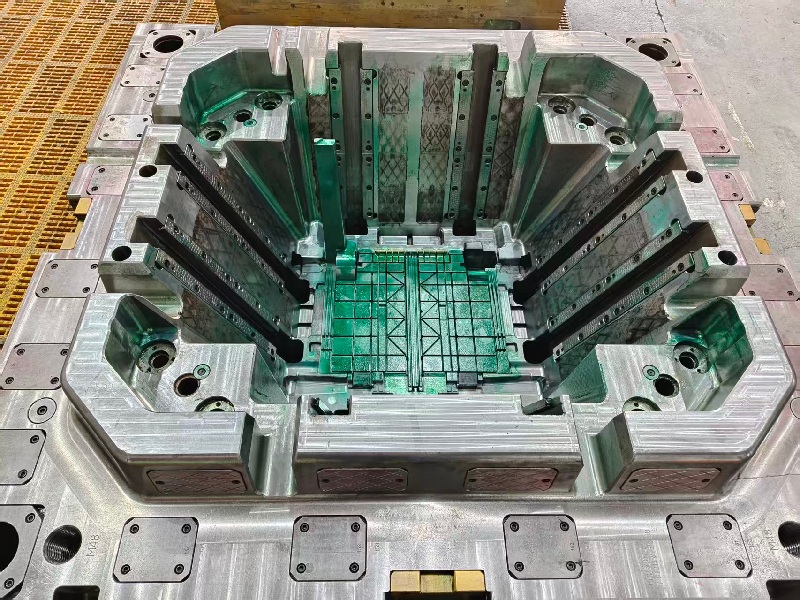

The mold base industry has experienced rapid development over the years, and the production, processing, and manufacturing of standard mold bases have become more mature than before. Beyond customization, standardized mold products can also be selected based on standardized production processes. The application of standard mold bases serves as the foundation for many products and is an essential tool for molding. As the backbone of molds, standard mold bases play a crucial role in production.
Manufacturing Process of Standard Mold Bases
During mold base cutting, operations must strictly adhere to the nominal dimensions and machining allowances specified in the drawings, using methods such as sawing or gas cutting. Measurements for length, width, and thickness should be taken with a tape measure or steel ruler to ensure sufficient machining allowance. Additionally, the difference in diagonal lengths should be checked to verify the basic accuracy of the plate’s right angles.
The rough milling process includes plane rough milling and four-side rough milling. After rough plane milling, the mold base is machined to leave a grinding allowance, while also removing unevenness on both sides of the plate and surface scale. Four-side rough milling reserves machining allowance for finish milling, eliminating uneven edges and saw marks to ensure the perpendicularity of the four corners.
When progressing to the rough cavity milling stage, the process leaves the necessary machining allowance for finishing, milling out concave-convex cavities, grooves, and forming surfaces on the plate. After rough grinding, a fine grinding allowance is retained, and the upper and lower surfaces of the plate are ground flat to meet parallelism requirements and achieve a certain level of surface brightness.
Some molds can be completed within 20 days, while others may not be finished on schedule even in a month. However, the general trend in the mold processing industry is toward increasingly streamlined processes. Many tasks no longer require extensive manual labor, thanks to the adoption of high-tech products, which saves significant time and ensures that the processed molds better align with production design standards.