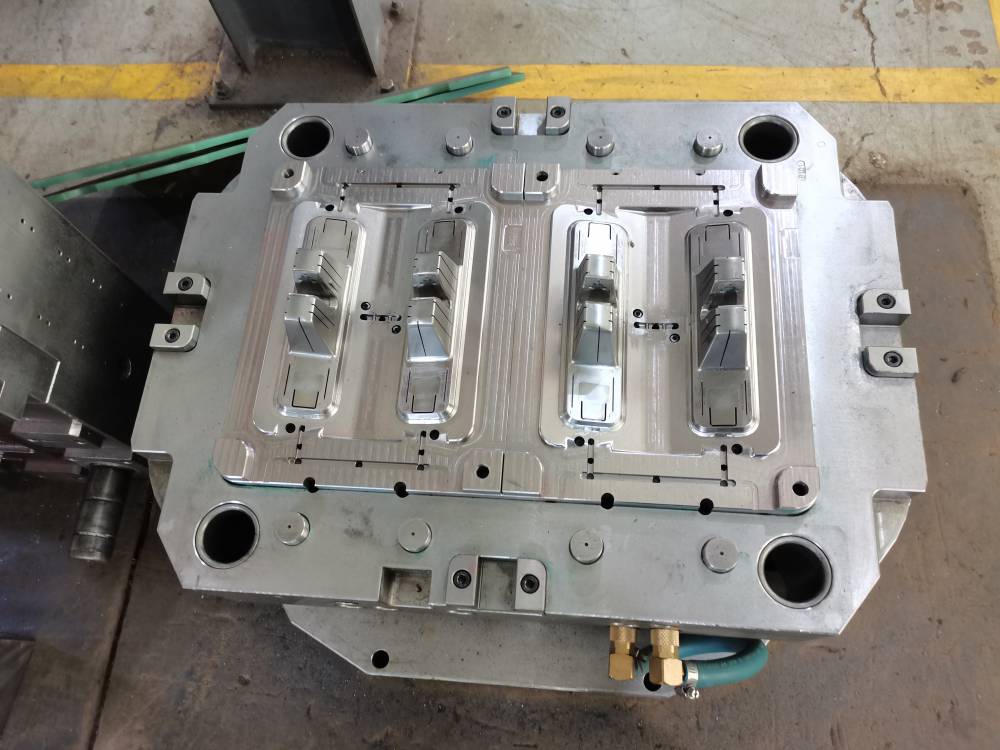

Mold Base: The "Industrial Skeleton" and Standardized Foundation of Molds
In modern manufacturing, especially in plastic and metal forming, molds are hailed as the "Mother of Industry." However, the core of a precision mold extends far beyond the cavity that directly shapes the product. Behind it lies a highly standardized steel framework that provides support and driving force—this is the mold base, often called the "industrial skeleton" of the mold. It serves as the fundamental cornerstone enabling efficient, standardized production in the entire mold industry.
1. What is a Mold Base?
A mold base, also known as a mold frame, is a standardized assembly consisting of multiple precision-machined steel plates. It does not directly contact the product; instead, its core functions are to carry, secure, and protect the most valuable and precise "heart" of the mold—the mold core and cavity—and to provide a stable, accurate operating platform for all mold movements, such as opening, closing, ejection, and cooling.
Think of a mold as a high-precision machine: The mold core and cavity are its core "executive components," responsible for the final shape of the product. The mold base, meanwhile, is its "chassis frame" and "transmission system," ensuring that the core components operate stably and reliably along the correct path.
2. Anatomy of a Mold Base: Core Components and Functions
A standard mold base primarily consists of the following key components, each with its own role:
- Structural Support Components: Clamping Plate / Top Clamping Plate, A Plate (Cavity Plate), B Plate (Core Plate), Spacers / Support Pillars, Bottom Clamping Plate. These form the main frame of the mold. The A and B plates house the mold core and cavity, while the spacers provide clearance for the ejection system.
- Movement and Guidance System: Guide Pins and Guide Bushings. They act as the mold's "navigation system," ensuring precise alignment over tens of thousands of opening and closing cycles. This is crucial for product accuracy and preventing mold damage.
- Ejection System: Ejector Retainer Plate, Ejector Plate, Ejector Pins / Sleeves, Return Pins. This mechanism gently pushes the cooled product out of the mold, enabling automated production.
- Auxiliary and Standard Components: Support Pillars (to reinforce the B plate), Stop Pins (to limit ejection travel), screws, dowel pins, etc.
3. Why is the Mold Base the "Standardized Foundation"?
The mold base plays a fundamental role as a cornerstone in the mold industry, primarily reflected in three aspects:
- Specialized Division of Labor and Cost Optimization:The mold base accounts for approximately 30% of the total mold cost. However, its manufacturing has been separated from mold makers and is undertaken by specialized large-scale mold base manufacturers (such as China's Changhui, Hongfeng, Zhonghua, or international leaders like Futaba, DME, HASCO). These manufacturers produce mold bases on a large, standardized scale. Mold makers simply select and purchase according to their designs, significantly shortening lead times and reducing costs through economies of scale.
- High Standardization and Interchangeability:Mold bases have evolved into complete standard series (e.g., LKM Standard by Lung Kee). Standardized dimensions, structures, and components allow for the global procurement and immediate replacement of wear-prone parts like guide pins, ejector pins, and screws. This greatly enhances mold maintenance efficiency and part interchangeability.
- Foundation for Quality and Precision:Professional mold base manufacturers utilize advanced equipment for mass production. Their processes for steel treatment, machining precision, and heat treatment far exceed what is feasible for single-piece processing in a typical mold shop. A high-precision, high-flatness, and high-strength mold base is the prerequisite for the entire mold to meet its lifespan and accuracy requirements.
4. Industry Landscape: From the Pearl River Delta to the Globe
The mold base industry reflects the development level of the mold industry. China's Pearl River Delta region, as a global hub for mold manufacturing, has fostered large-scale mold base manufacturers like Changhui and Hongfeng, which compete internationally and support the vast demands of China's manufacturing sector. In the high-end market, brands like Japan's Futaba, America's DME, and Germany's HASCO have set industry benchmarks with their exceptional precision, reliability, and global supply networks, making them the preferred choice for many precision and export molds.
Conclusion
The mold base, this seemingly bulky steel framework, is, in fact, the invisible guardian of the precision, efficiency, and reliability of modern mold manufacturing. It builds non-standard designs and processes upon a foundation of standardization, serving as the key bridge transforming molds from "works of art" to "industrial products." Just as a skyscraper relies on its foundational structure, behind every mass-produced plastic item stands the sturdy and standardized "industrial skeleton" of the mold base.