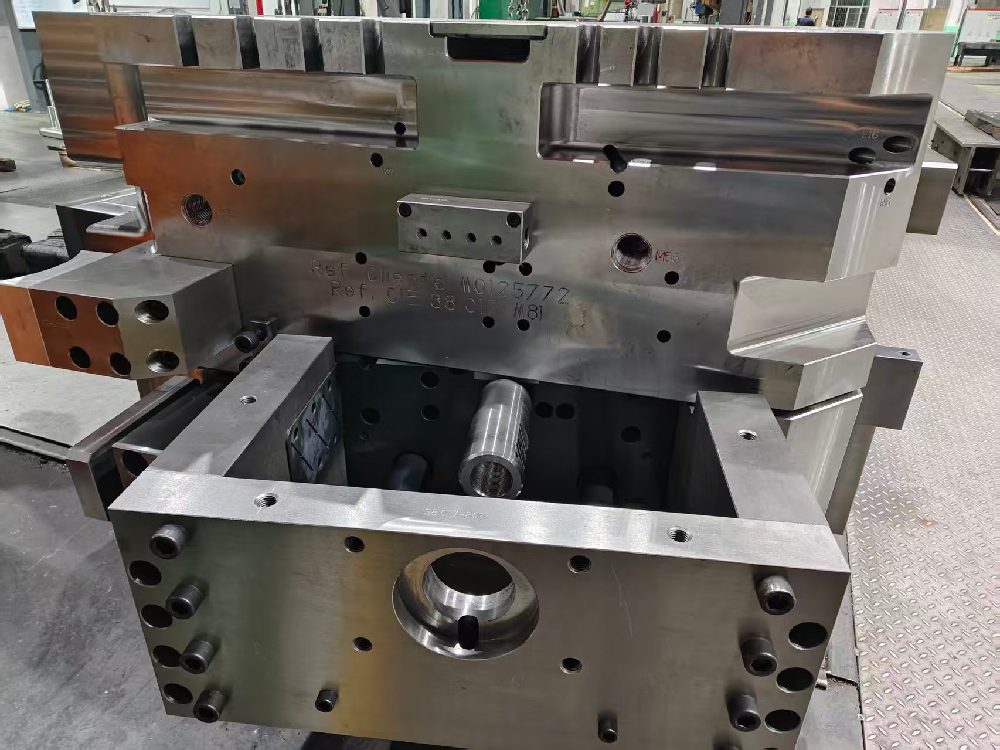

Common Types of Mold Bases
A mold base serves as a semi-finished framework of a mold, composed of various steel plates and components. It forms the "skeleton" of the complete mold. As the processing required for mold bases and molds differs significantly, mold manufacturers often purchase mold bases from specialized suppliers to leverage their respective production strengths, thereby enhancing overall quality and efficiency. Mold bases are widely used across industries. Below are four common types:
- Diagonal Guide Pillar Mold BaseTwo guide pillars—one large and one small—are symmetrically positioned on the diagonal of the lower mold base. In addition to sharing the advantages of the center guide pillar mold base, it allows for both longitudinal and transverse material feeding, making it highly convenient. Since its transverse dimension is larger than the longitudinal dimension, it is commonly used in multi‑station progressive dies with transverse feeding, as well as in single‑operation punching dies and compound dies with longitudinal feeding.
- Rear Guide Pillar Mold BaseThe guide pillars are located at the rear of the mold base, enabling convenient longitudinal and transverse material feeding. However, if eccentricity occurs during stamping or if the press guidance is inaccurate, the upper mold may tilt, causing uneven wear on the guide pillars/bushes and punches/dies, which can reduce mold life. It is generally employed for small to medium‑sized punching dies where high precision is not critical.
- Center Guide Pillar Mold BaseTwo guide pillars are symmetrically distributed on the left and right sides, ensuring balanced force distribution, smooth sliding, and accurate, reliable guidance. To prevent incorrect assembly of the upper and lower molds, the guide pillars and bushes are designed with different sizes (one large, one small). This structure only permits longitudinal feeding and is typically used for single‑operation punching dies, compound dies, or two‑station progressive dies.
- Non‑Through Hole Sleeve Plate Mold BaseThe fixed mold section consists of a fixed mold sleeve plate and guide pillars; the moving mold section includes a moving mold sleeve plate, guide bushes, spacer blocks, and a base plate; the ejection mechanism comprises an ejection plate, ejection plate guide pillars and bushes, return pins, and an ejector pin retaining plate. Non‑mold‑base components such as forming inserts, runner inserts, and sprue bushings are separately secured in their respective sleeve plates. This design requires fewer parts, involves less machining, and offers a compact structure, making it suitable for simple die‑casting molds.
What is a Mold Base?
A mold base is a semi‑finished assembly that forms the framework of a mold, constructed from various steel plates and parts. It acts as the "skeleton" of the complete mold. Mold manufacturers often procure mold bases from specialized suppliers to combine the strengths of both parties, thereby improving production quality and efficiency.
Today, molds are used in the mass production of virtually all kinds of products (e.g., automobiles, aerospace, daily necessities, electrical/communication equipment, and industrial machinery). As an integral part of the mold, the mold base’s precision requirements vary depending on product specifications. A range of mold base products (such as those from brands like LKM and Ping Jin) are available on the market to meet different customer needs in terms of accuracy and structure.